


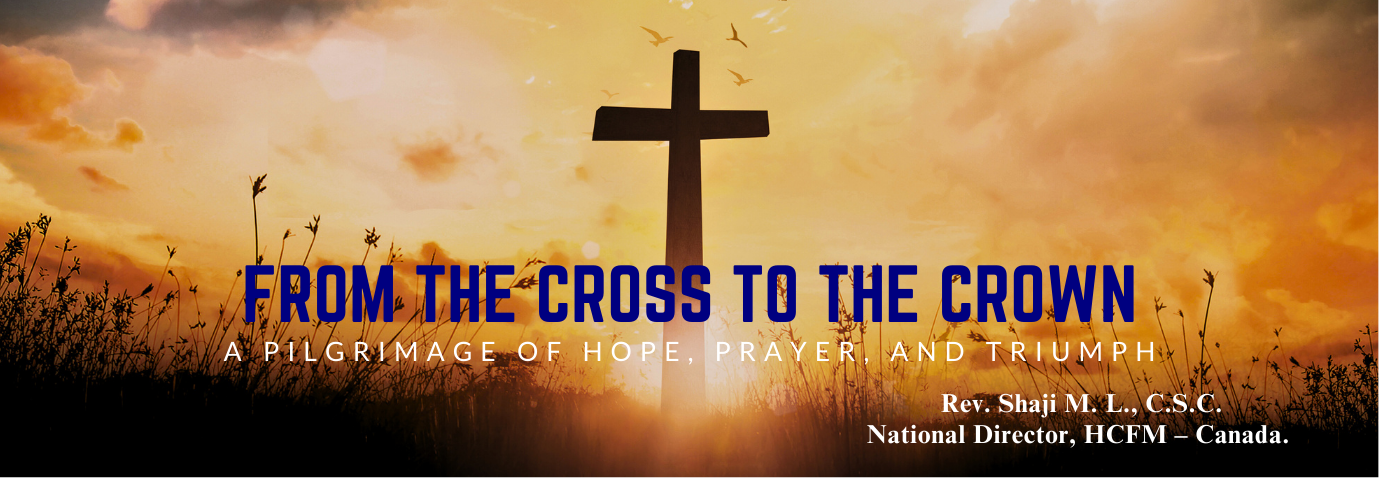
The Christian life is a sacred odyssey—one that begins at the foot of the Cross and ascends to the brilliance of the Resurrection. It is a journey not free from trials but rich in meaning, where suffering is transformed into grace and faith becomes the bridge from despair to divine victory. As Dietrich Bonhoeffer reminds us, “The cross is not the terrible end to an otherwise God-fearing and happy life, but it meets us at the beginning of our communion with Christ.”
This sacred path is traced through prayer, perseverance, and profound trust in God’s promises. The beads of the Rosary mirror our journey—each mystery a step deeper into the heart of redemption, each prayer a heartbeat of unwavering faith. Just as Helen Keller once said, “Although the world is full of suffering, it is also full of the overcoming of it.” The trials we face are not dead ends but doorways to transformation.
From the rugged ascent of Calvary to the radiance of Easter morning, we walk in the footsteps of saints and martyrs, knowing that beyond every cross lies a crown. The rhythm of faith sustains us, reminding us that the darkest nights give birth to the brightest dawns. As C.S. Lewis beautifully put it, “There are far, far better things ahead than any we leave behind.” Let us then walk this pilgrimage with hope in our hearts, prayer on our lips, and the assurance that in Christ, suffering is never the final word—glory is.
Golgotha’s Triumph: Love’s Ultimate Sacrifice: Golgotha, the Place of the Skull, bore witness to the most profound act of love—the crucifixion of Christ. As Jesus carried His cross, He shouldered not only the weight of the wood but the burdens of all humanity. The Catechism of the Catholic Church affirms, “By His Holy Cross, He has redeemed the world” (CCC 617). Yet, the Cross was never the conclusion; it was the threshold to victory.
Consider the courageous witness of St. Maximilian Kolbe, the Polish Franciscan who, within the horrors of Auschwitz, offered his life in place of a fellow prisoner. Like Christ on Golgotha, he embraced suffering with love, demonstrating that pain, when surrendered to God, becomes an instrument of grace.
The Passion of Christ is the bedrock of Christian discipleship. Jesus Himself calls us to walk in His footsteps: “Whoever wants to be my disciple must deny himself and take up his cross and follow me” (Matthew 16:24). The Church Fathers emphasize that suffering is woven into the Christian experience. St. Augustine poignantly observed, “God had one Son on earth without sin, but never one without suffering.”
Blessed Basil Moreau, founder of the Congregation of Holy Cross, grasped this mystery deeply: “We do not become saints without suffering, and we never sanctify ourselves alone.” The Constitutions of the Congregation of Holy Cross echo this truth: “We stand by the cross of Christ as Mary did, and so we hope for the grace of resurrection” (Constitution 8:31).
Prayer as the Soul’s Lifeline: Prayer anchors us to God on this pilgrimage of faith. The Rosary, often heralded as the “Gospel in beads,” invites us into deep meditation on Christ’s journey from agony to triumph. Pope St. John Paul II describes the Rosary as “a compendium of the Gospel” (Rosarium Virginis Mariae, 2002).When we pray the Sorrowful Mysteries, we walk alongside Jesus in His Passion—but we do not remain there. The Glorious Mysteries assure us that every suffering ultimately leads to Resurrection.
The potency of the Rosary is powerfully illustrated in the life of Fr. Patrick Peyton, the Apostle of the Rosary, who boldly proclaimed, “The family that prays together stays together.” His global mission of promoting family prayer stemmed from the conviction that prayer fortifies us amid trials and leads us to God’s glory.
Prayer is our spiritual oxygen: The Rosary, frequently called “the Gospel in miniature,” serves as a constant guide on our journey. Pope St. John Paul II emphasized, “The Rosary, though clearly Marian in character, is at heart a Christocentric prayer. It has all the depth of the Gospel message in its entirety.”
When the weight of life becomes overwhelming, prayer sustains us—just as Simon of Cyrene helped Jesus carry His cross. The Constitutions of Holy Cross reaffirm this: “Prayer binds us together in the Lord. In prayer, we meet the living God and find ourselves renewed” (Constitution 3:24).
A Paradox of Death and Life: The Cross, though a sign of suffering, is also the gateway to eternal life. St. John Chrysostom powerfully states, “The cross has torn up the account of our sins and cancelled our debt.”
A modern witness to this paradox is St. Mother Teresa, who, amidst the suffering of Calcutta, transformed despair into hope. She recognized the face of Christ in the destitute, affirming that every suffering soul bore “Jesus in distressing disguise.” Through the Cross, she reached the Resurrection.
The Rhythm of Faith: Trusting in Divine Providence Faith is the heartbeat of our spiritual journey—the pulse that sustains us through trials and propels us toward glory. Scripture assures us, “Faith is the assurance of things hoped for, the conviction of things not seen” (Hebrews 11:1). When the disciples encountered the Risen Christ, their sorrow turned to joy. Likewise, when we surrender our trials to God, they become stepping stones to triumph.
A shining example of faith in action is Blessed. Carlo Acutis, the young Italian teenager who utilized technology to spread devotion to the Eucharist. Even as he battled leukemia, he never lost sight of eternal life, proclaiming, “The Eucharist is my highway to heaven.” His witness reminds us that faith transforms suffering into a pathway to glory.
Faith is not merely belief—it is a lived reality. The journey from Golgotha does not culminate at the tomb; it bursts forth in the Resurrection. St. Paul declares, “If Christ has not been raised, your faith is futile; you are still in your sins” (1 Corinthians 15:17).
Blessed Basil Moreau envisioned the Holy Cross family as “Educators in the Faith,” shaping hearts and minds to reflect the light of Christ. The Constitutions of Holy Cross affirm, “The footsteps of those who follow Christ do not fade at the tomb; they pass beyond death to resurrection” (Constitution 1:8).
The Call to Witness: Walking the Path of Discipleship: As Christians, we are summoned to embrace this pilgrimage—carrying our crosses, persisting in prayer, and fixing our gaze on the Resurrection. The Church teaches that suffering, when united with faith, is never meaningless. Pope Benedict XVI once challenged us, “The world offers you comfort, but you were not made for comfort. You were made for greatness.”
A poignant testament to this truth emerged from the battlegrounds of World War II. A young soldier, lost behind enemy lines, clung to his Rosary for guidance. Each bead became a step of faith, leading him to safety. Later, he testified, “The Rosary was my map and my shield.” Like him, every believer must grasp the beads of hope and march forward with unwavering faith.
The Pilgrimage continues from the Cross to the Crown: From Golgotha to Glory, the Christian life is a sacred pilgrimage—rooted in the Passion, sustained by prayer, and crowned with Resurrection. Blessed Basil Moreau exhorts us, “Let us not abandon the Cross, for it is through the Cross that we shall reach the crown.”
May we walk steadfastly, bearing our crosses with love, clinging to our beads of hope, and marching in the rhythm of faith—until we behold the radiant glory of Christ, our Risen Lord.
Happy Easter!
Leave a Reply